



Facing hip replacement surgery naturally brings up one crucial question: how long does a hip replacement last? For patients considering a titanium hip replacement, understanding the overall titanium hip replacement lifespan is essential for making informed decisions about your treatment and planning your future.
A titanium hip has become the gold standard in orthopedic surgery, known for its exceptional durability and biocompatibility. But exactly how long do titanium hip replacements last, and what specific factors influence hip replacement joint longevity?
“The longevity of a titanium hip prosthesis depends on multiple factors, but with modern surgical techniques and proper patient care, these titanium hip implants routinely last 15 to 25 years or even longer, says Dr. Veeresh Patage, a leading orthopedic surgeon in Akshayanagar, Bangalore with over 15 years of experience in joint replacement surgery.
In this comprehensive guide, we’ll explore everything you need to know about the life expectancy of titanium hip replacement options, from expected lifespan to factors that can extend or shorten your implant’s life.
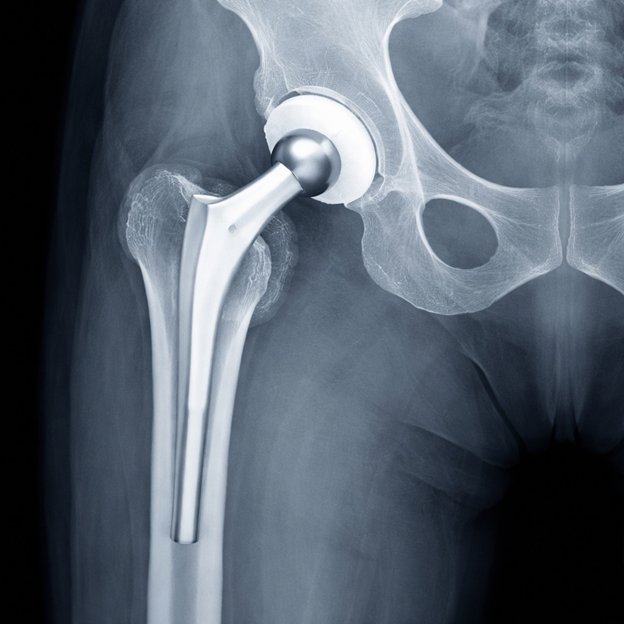
Titanium hip replacement implant showing durability and longevity
What Is a Titanium Hip Replacement?
A titanium hip replacement is a surgical procedure where a damaged or diseased hip joint is replaced with an artificial implant made primarily from a titanium alloy. This biocompatible metal has revolutionized hip replacement surgery due to its unique properties that make it ideal for long-term implantation in the human body.
Components of a Titanium Hip Replacement
As shown in the structural diagram below, a complete total hip arthroplasty relies on several interconnected components working smoothly together:
-
Femoral Stem: A sturdy titanium shaft inserted down into your thighbone (femur) for core stability.
-
Femoral Head: The smooth ball component—typically made of specialized ceramic or cobalt-chrome—that attaches firmly onto the stem.
-
Acetabular Cup: A durable titanium outer shell fixed directly into your pelvic socket.
-
Plastic Liner: A highly engineered polyethylene or ceramic insert nested inside the cup that creates a low-friction gliding surface for the ball.
Why Titanium Is the Preferred Material
Titanium has become the material of choice for hip replacements for several compelling reasons:
-
Biocompatibility: Titanium is highly compatible with human tissue, minimizing the risk of adverse localized tissue reactions.
-
Osseointegration: The raw metal surface bonds directly with natural bone tissue, creating an incredibly secure, permanent anchor over time.
-
Strength and Durability: Despite being incredibly lightweight, titanium resists daily heavy-load corrosion and physical material fatigue.
-
MRI Compatibility: Unlike older stainless steel components, modern titanium components meet rigid safety parameters, ensuring long-term titanium orthopedic implant safety during diagnostic MRI imaging.
“Titanium’s ability to integrate with natural bone creates a foundation that can last for decades, explains Dr. Veeresh Patage. This osseointegration is key to the implant’s longevity and the patient’s long-term satisfaction.”
How Long Does a Titanium Hip Replacement Last?
The average life expectancy of titanium hip implants sits comfortably between 15 to 25 years, with many patients enjoying extended functionality well beyond that. Large-scale clinical studies (such as long-term data published in The Lancet) reveal that roughly 58% of total hip joints continue to perform perfectly up to the 25-year mark. When patients ask, how long does a titanium hip last?, the answer is increasingly positive.
Research-Backed Longevity Data
According to recent orthopedic registry benchmarks:
-
Long-Term Success: Approximately 85% to 90% of modern titanium configurations remain fully functional at 20 years post-op.
-
Revision Rates: Thanks to material refinements, modern titanium systems demonstrate a revision rate of less than 5% at the 10-year mark.
-
Precision Technology: Advanced structural alignments specifically using Mako Robotic Total Hip Replacement have vastly improved the durability of titanium total hip arthroplasty by eliminating manual placement errors.
| Patient Age at Surgery | Expected Implant Lifespan |
|---|---|
| 50-60 years | 20 to 25+ years (Up to 35% of young men may eventually need a touch-up) |
| 60-70 years | 25-30+ years |
| 70+ years | Typically a lifetime (Risk of ever needing a second surgery is just 5%) |
Comparison with Previous Generation Implants
The overall total hip replacement surgery success rate and structural durability have improved significantly over the decades. Early structural designs from the 1970s suffered from early plastic wear and loosening. Today’s advanced titanium hip options offer substantially longer lifespans.
“With the precision offered by robotic-assisted surgery, we can achieve optimal implant positioning that wasn’t possible even a decade ago,” notes Dr. Patage. “This level of accuracy directly translates to better implant performance and a longer titanium hip replacement lifespan.”
The Role of Safety and Revision Surgery
Modern orthopedic advancements ensure that titanium orthopedic implant safety remains at the forefront of clinical practice. While the primary goal is a “once-in-a-lifetime” procedure, some joints may experience slow bone changes or wear out over several decades, making hip revision surgery a necessary step to swap out old components.
Why a Revision Might Be Needed:
-
Aseptic Loosening: Where natural bone begins to retreat or fail to stay bonded to the titanium over time.
-
Component Dislocation: Often caused by sudden physical trauma or muscle imbalances around the joint.
-
Periprosthetic Fracture: A structural break in the natural bone surrounding the implant shaft.
“Thanks to high-precision surgical planning, the modern total hip replacement surgery success rate remains exceptionally high, providing patients with peace of mind that their mobility can be safely restored if a secondary tune-up is ever required down the road.”
Ready to learn more about hip replacement options? Schedule a consultation with Dr. Veeresh Patage to discuss your specific needs and expected outcomes.
Factors That Affect Titanium Hip Replacement Longevity
While titanium hip replacements are built to last, several factors influence how long does titanium hip replacement last for your specific body.
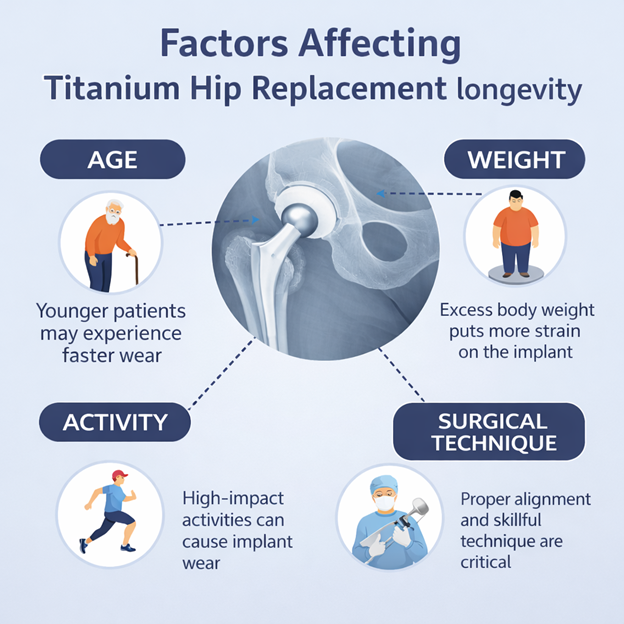
A. Patient-Related Factors
-
Age at Surgery: Younger, highly active individuals naturally place greater, more frequent mechanical stresses on an artificial joint compared to sedentary seniors.
-
Body Weight and BMI: Excess weight multiplies the mechanical loading forces across the hip. Maintaining a stable, healthy BMI lowers component friction.
-
Activity Level and Lifestyle: Your daily activities directly impact how long do titanium hip replacements last. High-impact sports accelerate bearing surface fatigue.
-
Overall Health and Bone Quality: Systemic conditions like severe osteoporosis affect the baseline quality of the bone anchoring the titanium components.
B. Surgery-Related Factors
-
Surgical Technique and Precision: Subtle manual alignment errors cause asymmetric friction wear. Robotic assistance achieves sub-millimeter positioning accuracy.
-
Surgeon Experience: High-volume joint specialists navigate individual anatomical variations more effectively, directly influencing the final implant lifespan.
How to Maximize Your Titanium Hip Replacement Lifespan
While your surgeon handles the intraoperative placement, your daily choices post-surgery directly dictate how long does a titanium hip replacement last.
1. Lifestyle Modifications
-
Weight Management: Every single extra pound of body weight adds roughly 3 to 6 pounds of joint impact force per step. Dropping even 10 pounds relieves massive pressure on the implant materials.
2. Choose Appropriate Physical Activities
-
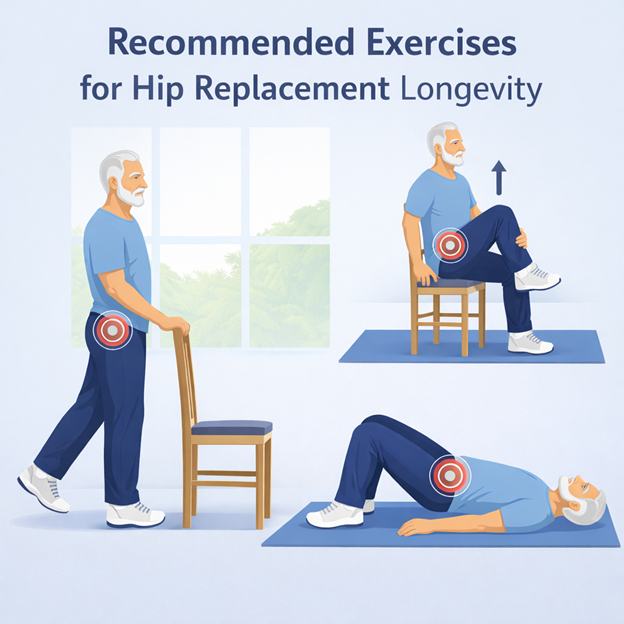
Highly Recommended (Low-Impact): Walking, smooth hiking, swimming, water aerobics, stationary cycling, golf, and dedicated lower-body resistance training.
-
Activities to Limit or Avoid (High-Impact): Long-distance jogging, contact sports (football, basketball), or repetitive high-load heavy weightlifting.
“I encourage my patients to stay active, but choose activities wisely,” advises Dr. Veeresh Patage. “The goal is to maintain fitness and quality of life while protecting your investment in the hip replacement.”
3. Follow-up Care and Monitoring
-
Routine X-Ray Check-ups: Regular visits (typically at 6 weeks, 3 months, 1 year, and every 2 to 3 years thereafter) allow your surgeon to spot painless, early signs of hip joint wear or bone thinning before severe complications develop.
-
Focused Physiotherapy: Completing your physical therapy rebuilds the core stabilizing muscles around the joint, taking structural stress off the mechanical implant components.
4. Listen to Your Body
Do not ignore potential warning signs of hip joint wear or shifting components. Contact an expert if you experience:
-
New, deep-seated groin or thigh pain.
-
A sudden change in your walking gait or a new limp.
-
Audible clicking, grinding, or popping sensations inside the hip area.
“I encourage my patients to stay active, but choose activities wisely,” advises Dr. Veeresh Patage. “The goal is to maintain fitness and quality of life while protecting your investment in the hip replacement.”
3. Follow-up Care and Monitoring
Regular Check-ups and X-rays
Routine follow-up appointments allow your surgeon to monitor your implant’s condition before problems become serious. Your typical follow-up schedule involves:
- 6 weeks post-surgery
- 3 months post-surgery
- 1 year post-surgery
- Every 2-3 years thereafter, or as recommended
X-rays during these visits help detect early signs of wear, loosening, or bone changes around the implant.
Importance of Physiotherapy
Completing your prescribed physiotherapy program is crucial for long-term success. Physical therapy:
- Strengthens muscles that support and protect your hip
- Improves range of motion and flexibility
- Teaches proper movement patterns to reduce implant stress
- Helps maintain healthy bone density around the implant
4. Daily Care Tips
Prevent Falls and Injuries
Falls can cause serious damage to your hip replacement. To stay safe:
- Remove tripping hazards from your home (loose rugs, clutter)
- Install grab bars in bathrooms
- Ensure adequate lighting throughout your home
- Use appropriate assistive devices if needed
- Wear supportive, non-slip footwear
Nutritional Support for Bone Health
Maintain strong bones around your implant through:
- Adequate calcium intake (1,000-1,200 mg daily)
- Vitamin D supplementation as recommended by your doctor
- Protein-rich diet to support muscle and bone health
- Avoid excessive alcohol and quit smoking
Listen to Your Body
Pay attention to warning signs:
- New or worsening pain
- Increased swelling or warmth
- Clicking, popping, or grinding sensations
- Feeling of instability or the hip ‘giving way’
Contact your orthopedic surgeon promptly if you experience any concerning symptoms.
Need personalized guidance on maximizing your hip replacement longevity? Contact Dr. Veeresh Patage for expert advice tailored to your situation.
Conclusion
A titanium hip replacement is a life-changing investment in your daily mobility. When evaluating the life expectancy of titanium hip replacement choices, you can confidently anticipate a functional lifespan of 15 to 25 years, and frequently longer under proper care guidelines.
Your physical habits, weight management, and the baseline alignment precision of the surgery determine your hip replacement joint longevity. Dr. Veeresh Patage brings over 15 years of orthopedic joint expertise to Akshayanagar, Bangalore, integrating leading Mako Robotic-arm precision to maximize how many years does an artificial hip last for your specific lifestyle.
Ready to restore your mobility with confidence? Schedule an expert consultation with Dr. Veeresh Patage today to map out a long-term plan for your joint health.
Frequently Asked Questions
Can a titanium hip replacement last 30 years or more?
Yes. Modern manufacturing methods combined with a low-impact lifestyle allow modern titanium hip implants to comfortably cross the 30-year mark, particularly in patients who undergo surgery later in life.
Does weight affect how long a titanium hip replacement lasts?
Yes. Higher physical body weight puts increased load on the internal titanium hip prosthesis, which speeds up the gradual wear of the protective plastic liner inside the cup.
How often should I get my titanium hip replacement checked?
To preserve titanium orthopedic implant safety, you should receive an expert clinical check and a baseline digital X-ray every 2 to 3 years to look for silent signs of hip joint wear or subtle implant loosening.
What activities can reduce the lifespan of my titanium hip replacement?
Repetitive high-impact activities like running, competitive singles tennis, or heavy squat lifting put extreme force cycles through the components, threatening the overall durability of titanium total hip arthroplasty.
At what age does a titanium hip replacement typically last the longest?
The relative longevity of the device is highest in individuals who receive surgery between ages 60 and 70+. Because physical activity profiles are naturally more moderate, the life expectancy of titanium hip replacement systems easily covers the remainder of the patient’s lifetime.

References
- American Academy of Orthopaedic Surgeons (AAOS). (2024).
Total Hip Replacement.
View Source - National Joint Registry (NJR). (2023).
Hip, Knee, Ankle, Elbow and Shoulder Replacement: Annual Report.
View Source - The Journal of Bone & Joint Surgery. (2024).
Long-term survivorship and patient satisfaction of contemporary total hip arthroplasty.
View Source
Disclaimer: The information shared in this content is for educational purposes only and not for promotional use.